
For 450 million years, plants and soil fungi have been trading partners. The fungi weave through plant roots, delivering phosphorus and other soil minerals in exchange for sugars and fats produced by the plant through photosynthesis. This ancient collaboration supports roughly 80% of Earth's plant species—including corn, wheat, and other crops that feed billions of people.
Scientists have long understood that these partnerships matter for agriculture. What they haven't understood is exactly how plants and fungi coordinate at the molecular level to build and maintain their relationship.
Now, a team from the Boyce Thompson Institute (BTI), led by Professor Maria Harrison, has coupled two powerful tools that allow scientists to identify which proteins work together to make these partnerships function—and to verify those interactions in living plant roots, where the collaboration actually occurs.
Proteins are molecular machines that carry out nearly every function in living cells. For plant-fungus partnerships to work, specific proteins must physically connect and cooperate. Identifying which proteins partner with which has been technically difficult because the specialized cells where plant-fungus exchanges occur are rare, making up only a tiny fraction of root tissue.
"We've known for years that certain proteins are essential for establishing these symbioses, but we couldn't see who they were working with," said Harrison. "These tools let us ask—and answer—those questions in the cells where the partnership actually happens."
Working as postdoctoral researchers in Harrison's lab, Sergey Ivanov, Lena Müller, and François Lefèvre combined and modified a complementary pair of approaches. First, they generated a library of plant and fungal proteins. These are used in a screening system in yeast cells, which tests the protein of interest for its connections with thousands of potential partners, with results read through DNA sequencing. Think of it as a high-throughput matchmaking service for proteins.
The second tool, which is an adaptation of a method used widely in biology, makes proteins glow only when they physically touch inside plant root cells. This fluorescence-based method confirms that partnerships identified in yeast actually occur in the right place in living plants—at the cellular membranous "trading floor" where nutrients change hands.

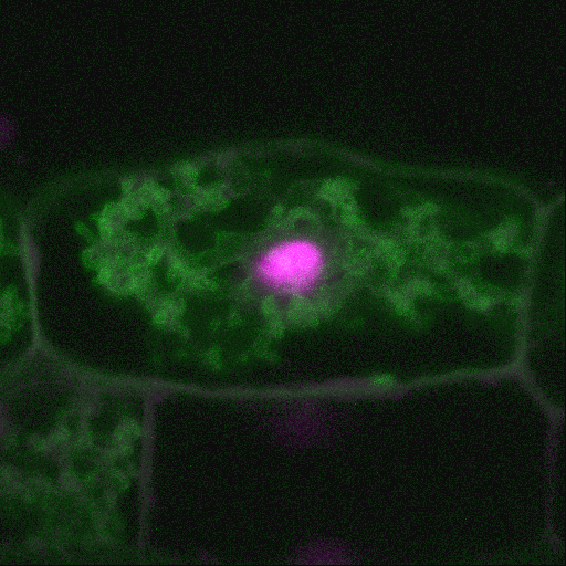
"The beauty of combining these two methods is that we can cast a wide net to find candidate partners, then test whether those interactions are happening in the right location," said Ivanov, lead author of the study. "That second step—verification in living roots in the correct cells and the correct space inside the cell—has been a bottleneck in the field."
To demonstrate that their tools work, the team studied a protein called CKL2, which previous research had shown to be essential for plant-fungus partnerships. Without CKL2, the relationship fails to develop properly.
The screening revealed that CKL2's top partners belong to a family called 14-3-3 proteins—molecules known to connect other proteins and regulate important cellular processes. The fluorescence test confirmed these proteins interact at the periarbuscular membrane, the specialized boundary where plants and fungi exchange nutrients.
When researchers reduced 14-3-3 protein levels in plant cells, fungal colonization dropped by about 31%, suggesting that these proteins play a meaningful role in sustaining the partnership.
Understanding precisely how plants and fungi coordinate their partnership at the molecular level provides researchers and plant breeders with targets for developing crop varieties that form more effective symbioses. Crops that extract phosphorus and other nutrients more efficiently through fungal partnerships would require less synthetic fertilizer—cutting input costs for farmers while reducing fertilizer runoff.
The research team is making these resources available to the broader scientific community, providing other laboratories with tools to study additional proteins essential to this widespread and agriculturally important biological collaboration.
"We can now systematically identify which proteins control nutrient exchange and verify their interactions in living roots," said Harrison. In addition to improving nutrient uptake, these plant-fungi partnerships also help bolster plant resilience against disease and environmental stress.
The study was published in New Phytologist, and funding was provided by the US National Science Foundation and the TRIAD Foundation.